|
Briefing: NHS reform in the Holyrood manifestos |
Related newsNHS Fife awarded university status Government promises to up NHS activity ‘Bleak picture’: health leaders react to NHS review Labour wants clinician-led ‘revolution’ of NHS Health secretary promises reform for NHS Making cervical cancer a ‘rare disease’ 
|
|
|
||
|
||
|
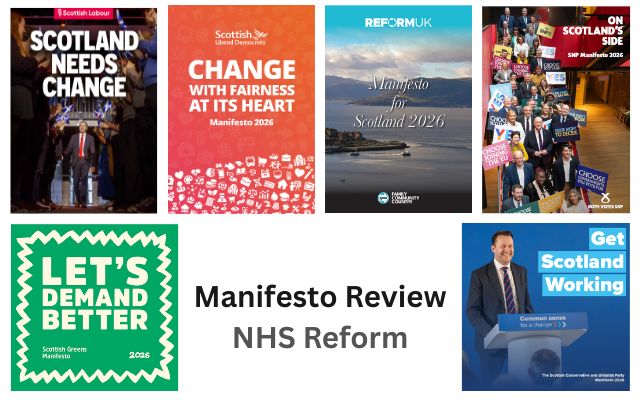
The delivery of services by the NHS is consistently one of the top two subjects, alongside the economy/cost of living, that voters want the next Holyrood parliament to do better. In the second review of the election manifestos of the main political parties, we look at the promises being made on the structure and priorities for the NHS, and commitments on technology.
All the main political parties commit to increasing investment in the NHS in Scotland, to maintaining the NHS in public ownership and for its services to be free at the point of delivery.
They all say they will increase the proportion of the overall health budget spent on primary care and general practice.
Structure and management
The SNP say they will adopt a 'once for Scotland' approach to reducing duplication of corporate activity, ‘ensure acute services are supported in the most efficient manner possible’ and ‘substantially’ consolidate the number of health bodies.
Scottish Labour’s starting point is a promise to reduce the number of territorial NHS boards to three, cutting the number of chief executives and directors, while reviewing and reducing the number of national NHS boards to fewer than five. They say this will allow more funding to go to local communities through ‘reformed health and care partnerships’.
Labour also wants to move to an NHS funding model where funding directly follows the patient, and where NHS boards are ‘incentivised to maximise their capacity and improve their productivity’ by only being paid for the work they carry out.
The Scottish Conservatives say they will double general practice funding to 12% of the health budget. They promise not to close any community hospitals or local health centres across Scotland for five years.
The Scottish Greens say they will implement a worker-led reform programme for the whole of the public sector to improve performance and make savings, whilst ‘rejecting the policy of austerity disguised as ‘efficiencies’ which has devastated public services since 2010’.
The Greens say they will reform the funding and structure of Integration Joint Boards to enable stronger local investment in prevention and community-based care.
Improving productivity
In their manifesto, Reform UK says it will establish an independent Scottish Healthcare Reform Commission ‘to review healthcare delivery and form action plans on the workforce, discharge solutions, long-term funding for adult social care, a shift to a prevention strategy to tackle health inequalities, expansion of frontline services, and improvements in technology and AI’.
Scottish Labour says it will take a ‘One Scotland’ approach to procurement and innovation ‘to reduce variation between regions and speed up the adoption of new technologies and medications’.
Labour also says it will ensure people waiting for treatment can travel to other NHS board areas and to England.
The Scottish Liberal Democrats say they will work with private providers where their services can bring down waiting times for patients, reduce costs and complement NHS services, so long as the commitment to universal healthcare free at the point of delivery is not compromised.
The Scottish Conservatives say they will put more money into ‘frontline care’ by consolidating NHS back-office functions and reducing the number of senior managers. They say they will also reduce bureaucracy by ending mandatory reporting on things like the NHS biodiversity action plans.
The SNP say they will ‘rebalance care’ towards early intervention and community prevention by expanding Hospital at Home services across the country.
Technology
All the parties commit to improving technology in the NHS – with most saying they will roll out an NHS app for patients. To speed things up, Reform UK says it will adopt the NHS England App.
The Scottish Conservatives say they will deliver a “One NHS” IT platform to reduce the need for patients to repeat their medical history each time they are in a different NHS setting. They also say they will ‘roll out AI across the NHS to cut down on administration costs’.
The SNP’s technology shopping list includes providing a number of additional services on the new MyCare.scot app, including a national booking system for NHS appointments, and completion of the move to paperless digital prescribing.
Scottish Labour promises a similar list: an NHS app and ‘patient portal’ available in every health board area within the first 100 days, electronic prescribing and app-based repeat prescriptions, and a single patient record.
Labour says it will also expand the availability of NHS-approved wearable technology to provide real-time data, and invest in AI-enabled MRI and CT scanners to help detect cancer early.
Read about some of the manifestos published by Scottish organisations ahead of the Scottish election: Dementia care in Scotland failing families; BMA: 2026 can be “watershed moment” for NHS; Parties must explain how they’ll save the NHS; Call for care home nurses to be given pay parity; More younger Scots dying from stroke; Call to address climate impact of medicines
Sign up to receive our bulletin for key health & social care updates straight to your inbox. |
