|
Pain assessments meet AI in Scotland’s care homes |
Related newsNew model can predict pre-eclampsia risk Being bad at healthcare innovation ‘is a choice’ Adopting innovation can be ‘Once for Scotland’ Camera endoscopy to be backed with AI Navigating ‘next frontier’ of AI in medical devices Multiple Sclerosis register a ‘powerful new resource’ New health & social care governance initiative EU staff qualifications & registrations confirmed Westminster committee launches drug misuse inquiry "Poverty remains a problem" for children in Scotland Financial balance pursued by NHS Lothian 
|
|
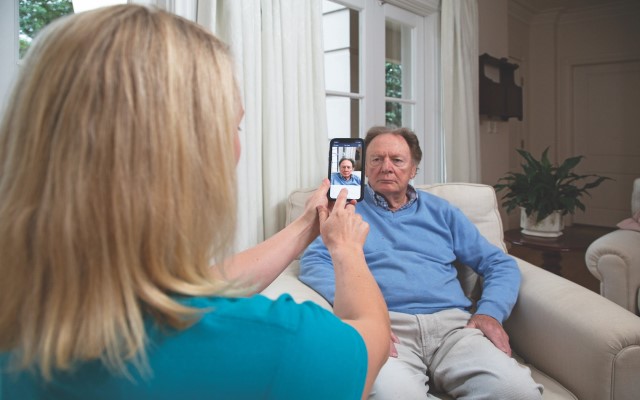
Image Credit: © PainChek
|
||
|
||
|
An app which uses facial analysis supported by artificial intelligence to assess pain levels is set to be trialled in 15 care homes across Scotland.
Following the Global Ageing Conference recently held in Glasgow, healthandcare.scot has heard from both the team behind the technology, PainChek, and the Care Inspectorate which is supporting its roll out about the potential of this innovation to improve the care for those who struggle to communicate their pain level.
The Australian start-up’s technology analyses the faces of patients who are unable to verbalise or otherwise communicate their pain level – looking for micro-expressions of pain.
The medical device application for assessing and managing pain, PainChek® has already been trialled in a handful of Scotland’s care homes.
Reviewing its outcomes, Dr David Marshall, Senior Improvement Officer for Pharmacy with the Care Inspectorate shared that PainChek® has been linked to a 42% reduction in falls among residents after six months.
It has also been associated with an increase in the number of pain assessments completed, more appropriate use of pain medication plus a general reduction in the prescribed rate of pain medication.
PainChek’s Head of Business Development UK&I,Tandeep Gill, says the initial pilot delivered these positive health and care outcomes thanks to pain being “promptly identified and monitored” through the PainChek® system.
Now, in its 2023/24 quality improvement plan, Scotland’s care regulator has signalled its intentions to expand use of PainChek® in a phase two trial across Scotland.
The phase two trial will test PainChek® across 15 care services to gather more information on its effect on medication and quality-of-life, as well as its adoptability and longer-term sustainability.
This will include tests in different user settings, service types, user groups and geographical locations, says the Care Inspectorate.
A spokesperson for the Care Inspectorate explained the potential of PainChek®, telling healthandcare.scot:
“We welcome the use of innovation and technology to help support people to experience the best possible care.
“This device should enable more appropriate use of medication and improved quality of life for care home residents.
“In future the device may also be able to support detection of pain in young children who are unable to adequately communicate pain.”
Empowering caregivers and patients
Particularly useful for patients with dementia and other cognitive impairments according to PainChek, a 2021 study in UK care homes found that PainChek® has the potential to support healthcare providers to improve quality-of-life residents with dementia.
The study concluded that it has ‘the capacity to empower caregivers to accurately assess, treat and manage pain in care homes’.
A spokesperson for the Care Inspectorate told healthandcare.scot why it is important to take advantage of digital innovations like PainChek®:
“The Care Inspectorate is committed to supporting services across Scotland to provide the best possible care for everyone, respecting their needs, rights and choices.
“However, some people experiencing care find it more difficult to communicate their needs than others, and digital innovation can help to ensure that everyone receives the help and support they need.”
Tandeep Gill, PainChek’s Head of Business Development UK&I, shared how the technology can support staff and carers – and give patients a voice:
“Using PainChek®, carers can record meaningful pain data, allowing them to address the shortfalls in pain documentation and treat pain according to evidence-based pain management practices, as well as use the data to plan person-centered, long-term care.
“This can enhance engagement with GPs and allied healthcare professionals, and ensure more collaborative, joined-up care and informed decision-making.
“Technology can lift many administrative burdens from care staff, in turn driving efficiencies and productivity, improving job satisfaction, and giving carers back the time to interact with residents.
“Importantly, those unable to reliably communicate their pain are given a voice.
“In addition, relatives can rest assured that their loved one is comfortable, and their pain is being managed and treated effectively and appropriately.”
Mr Gill told healthandcare.scot that one of the key challenges to the wider adoption of PainChek® is the lack of wider-spread use of new digital systems across health and care.
He said that while many care homes have embraced technology, others have not. He hopes that – with government targets and the right support – this is changing.
Mr Gill says PainChek is looking to see this second pilot improve pain assessment and enhance overall quality-of-care, adding:
“By achieving positive outcomes for care home residents and the care staff involved, we hope to gain the opportunity for a broader government-funded rollout across Scotland.”
Read more: Redefining clinical meaningfulness; Opinion: The case for care home research; Carers at a health and poverty tipping point; Music's potential to help with dementia
Sign up to our bulletin for key health & social care updates straight to your inbox and you can follow healthandcare.scot on Google News. |