|
Award for “pioneering” Scots 3D bone scaffold research |
Related newsAI for lung cancer care to help tackle “hidden killer” Collaboration on NHS procurement key to healthy future AI to help take pressure off A&E Social robots show potential in patient support Scottish health research collaboration extended Digital health: This is the moment Scotland reaches heart valve treatment milestone Medical trainee abuse reports ‘shut down and silenced’ Politicians must take ‘bold’ action on child poverty Glasgow district nurses ready to strike NHS and Glasgow rethink routes into healthcare "Landmark" newborn test rollout begins in Glasgow 
|
|
Image Credit: © Gorodenkoff
|
||
|
||
|
Scottish research into the development of 3D-printed personalised “scaffolds” for hip and knee joint replacements that adopts a patient’s own stem cells has received international recognition.
Led by orthopaedic specialists at NHS Golden Jubilee Hospital and biomedical engineers at the University of Strathclyde, the study explored the potential of mixing a patient’s biological cells with synthetic material to improve outcomes.
Now, the research paper has gained an international award for its influence in the field of orthopaedics.
As the second most commonly transplanted tissue worldwide, over four million operations use bone grafts of substitute materials every year to treat bone defects.
Researchers proposed that there would be a smaller risk of the body rejecting the joint with this three-dimensional bioprinting process.
Alongside stem cells, other substances usually found in bones – like calcium – were adopted.
Instead of full joint replacements containing metal which can wear out or come loose, these ‘bioactive composites’ could heal into place within patients, the researchers explain.
Developing bioactive scaffolds to support a person’s bone regeneration has now become a key area of focus within bone tissue engineering.
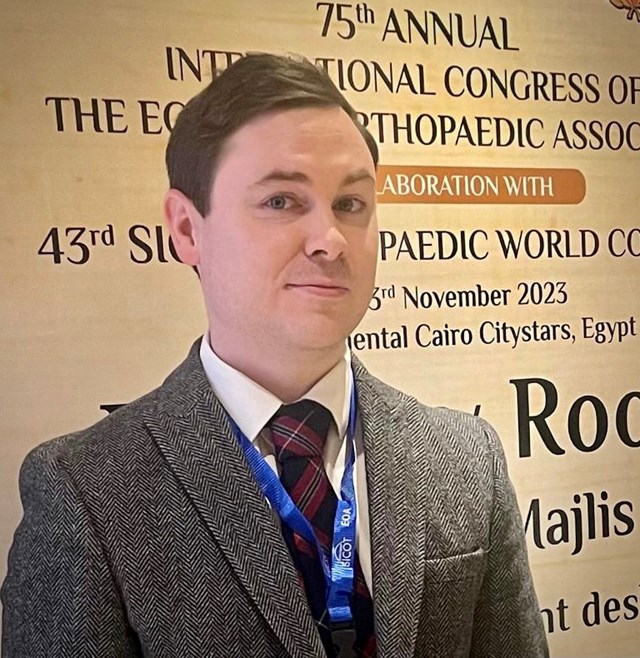
The primary author, Gareth Turnbull, said:
“The reason we looked into this area is because a lot of patients can develop significant bone loss or destruction due to a number of conditions such as arthritis, cancer, infection or trauma.
“When patients lose bone it can be a difficult and time-consuming process to regenerate or heal these defects.
“The idea is that by using 3D printing technology combined with biological components such as patient stem cells, we’ll be able to produce live biological implants that could be placed into patients and heal into place within them, instead of the current alternatives like metal implants, which can fail over time in the body as they wear out or come loose.
“The main benefit for patients would be that instead of having your tumour or bone defect treated with an artificial implant, or having your arthritis treated with joint replacement, you would be able to receive a biological implant that would potentially contain your own cells that would then grow into your own body and become part of you.”
Now, the ‘landmark’ research study, published in Bioactive Materials, has been awarded Best Paper from more than 200 papers published over the last decade by the journal.
Cited by more than 1,000orthopaedic specialists in the past six years, the study contributed to the development of bioactive 3D scaffolds to support bone regeneration as a key area of focus within the field.
Professor Jon Clarke, co-author and current Orthopaedic Research Lead at NHS Golden Jubilee, says this emphasises the importance of innovation within the NHS.
InnoScot Health commissioned research has found that most NHS Scotland staff agree ‘innovation must be at the heart of improving NHS Scotland services’, with 98% reporting they are motivated to contribute to innovation to improve patient and staff wellbeing.
Professor Clarke says this research and its recognition also highlights the potential of Scotland’s clinical orthopaedic research collaboration:
“Innovation that benefits patients is always high on our agenda and this award highlights this work.
“Joint replacements, like any mechanical devices, will eventually wear out, often within the lifetime of the patient. Biological constructs offer the potential for longer term survival, which could avoid the need for further operations.
“The award and recognition is testament to the strength of the long collaboration that our orthopaedic team has had with the University of Strathclyde.
“It also highlights the huge potential of our Orthopaedic Research Fellow Programme where aspiring academic trainees, like Gareth, can be nurtured to their full potential in order to produce high impact studies.
“We’re very proud that our paper has been cited by other researchers so many times and we are very much looking forward to seeing where this research leads us in the near future.”
Currently performing around 30% of all hip and knee replacements in Scotland, the orthopaedic team at NHS Golden Jubilee leads the way in a number of innovative techniques, including the use of robotics in joint replacements and enhanced recovery after surgery (ERAS) pathways.
Co-author Will Shu, Professor of Biomedical Engineering at the University of Strathclyde, shares Professor Clarke’s perspective on the power of collaboration with the NHS:
“Our collaboration with NHS Golden Jubilee represents a significant leap forward in surgical technology.
“By combining our expertise in 3D bio-printing with their pioneering techniques in orthopaedic surgery, we're not just enhancing current treatments but revolutionising them.
“This award is a testament to the global recognition of our partnership within the international research community.”
While already influencing the research field, Professor Clarke adds that this technology could be adopted into regular patient treatment for bone defects within the next decade.
A representative from NHS Golden Jubilee told healthandcare.scot that future therapies based on this research could avoid tissue rejection:
“Tissue regenerative therapies in which patients are given 3D printed implants derived from their own stem cells is a hugely promising route to treat a number of potential pathologies, however, it is still largely in its experimental stages and so is not yet at a stage where it can be adopted into clinical practice.”
“A key advantage of using human stem cells for tissue repair is that they can be easily derived from patients themselves and would not trigger an immune response, hence avoiding rejection.”
Read more: Making cervical cancer a ‘rare disease'; Broken hearts can be as deadly as heart attacks; Edinburgh team seek new insights into MS progression; ‘Most extensive' liver disease study backed by £30m; Genome research sees £46.3m boost; Biomarkers can improve melanoma patient care
Sign up to our bulletin for key health & social care updates straight to your inbox and you can follow healthandcare.scot on Google News. |