|
Link to research for breast cancer patients |
Related newsScotland must prioritise new bladder cancer test Ancestry clues to lottery of who gets cancer Discarded bowel tests offer ‘unparalleled’ insights Conference to build on cancer research partnerships Matching breast cancer patients to newest trials Dundee celebrates part in ‘phenomenal’ cancer study 
|
|
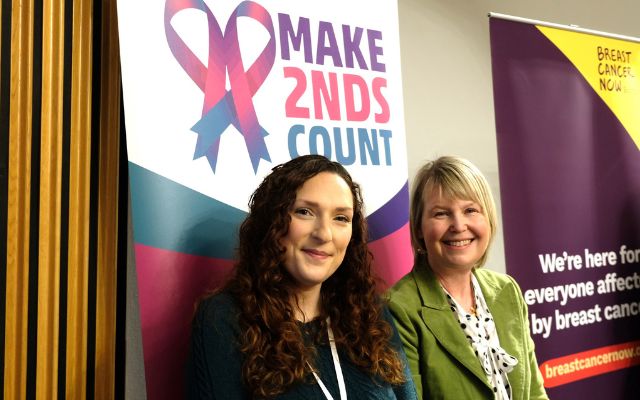
Emma Hall (left) and Lesley Stephen, Make 2nds Count
|
||
|
||
|
Partner Content: This article has been funded by Novartis Pharmaceuticals UK Ltd following a meeting organised by the company held at the Scottish Parliament.
A Scottish charity for people living with later stage breast cancers and their families is expecting this summer to match its 1,000th patient with a clinical trial for a new treatment that might help prolong their life.
Make 2nds Count says the window of opportunity for people to receive experimental treatments is often quite small and too few people living with secondary breast cancer find out if they might be eligible to be enrolled into one of the many studies taking place across the UK at any one time.
Lesley Stephen has been living with metastatic, late stage, breast cancer for 11 years. The turning point came for her when she was given a new medicine as part of a clinical trial.
“I owe much of that time,” she told a meeting in the Scottish parliament, “to a phase one clinical trial that I joined, thanks to my oncologists at the Western General in Edinburgh and the Beatson in Glasgow.
“Prior to me going on that trial in 2015 I was told to get my affairs in order, so it's really been literally a lifesaver for me. It enabled me to live well and achieve some of the milestones with my family that I didn't think I was ever going to see.”
The experience led Lesley to become a patient advocate working with various charities, and a trustee of Make 2nds Count, a charity focused on metastatic breast cancer.
“I'm trying to provide a voice for women who are living less well with the disease than me,” she said.
Emma Hall, Executive Director at the charity, told the meeting that living with a metastatic diagnosis – that the cancer spread to other parts of their body – is both mentally, mentally and physically gruelling, for the patient and their loved ones.
The charity researches ways to improve quality of life for patients and offers peer support, including face to face and online groups and wellbeing retreats, for hundreds of people affected.
“The biggest part of our work,” Emma said, “is now our focus on empowering patients through increasing their knowledge and understanding of research and treatments.
“We offer a free information service, called our clinical trial service, to all patients so they can get a referral or refer themselves to a clinical trial. People can speak to one of our clinical trial nurses who will look into options for clinical trials for them.
“With that information, they can take that to their oncologist and have a talk about clinical trials to see if that is an option as part of the treatment pathway.”
The meeting on secondary breast cancer at the Scottish parliament heard that, from setting it up in 2021 to the end of January 2025, 853 people had been referred to a clinical trial by the service.
This year, Make 2nds Count also hopes to hold a second scientific conference for patients across the UK to meet, and hear about treatments from, different cancer research teams.
The power to ask
The charity sought help from with the universities of Liverpool and Warwick to ask patients with metastatic breast cancer about their needs and experiences – and their thoughts on taking part in a clinical trial.
Lesley Stephen says that survey found it was a lack of information that was the biggest hurdle to people joining a trial:
“We wanted to know why more women don't seem to access clinical trials given my own very positive personal experience of one. Trials can be a potential new treatment option for patients who have a limited number of treatment lines. They advance our understanding of the disease through research, and give patients hope, which is what I as a patient – and I think my other fellow patients – really want.”
The survey showed fewer than a quarter of patients had ever had a conversation with their clinician about a clinical trial, and even fewer had actually been enrolled onto a trial.
“There were lots of misunderstandings and a general lack of information about trials,” Lesley said.
“People thought they were a last resort or that they'd be given a placebo rather than an alternative cancer treatment – or be treated as a guinea pig. They were concerned about how far patients might have to travel and what the cost might be, not knowing that patients’ costs are met.
“The only reason I knew about clinical trials was because of a friend who had blood cancer and was being flown down to the Royal Marsden Hospital in London every month for treatment, and the company behind the new medicine were paying for her expenses. I thought that was amazing. She did really well, and it turns out that the medicine she was on is now ‘standard of care’ for her type of blood cancer.”
Lesley accepts that being told your cancer is metastatic is a shock in itself, and the thought then of being part of research is a lot for people to cope with. But, she said, the survey respondents were generally keen to consider it.
“Not everyone will get onto a trial who asks – for many there won’t be one that’s suitable. But we hope they’ll know more, they’ll be a bit more empowered to ask their clinician.
“Equally, I hope, as more clinicians become aware of the service, they won’t just talk about the trials they know about but also point people to our service to find out about research going on somewhere else that they might be able to get involved in.”
You can find out about the clinical trials service on the Make 2nds Count web pages.
Read more: Closing the breast cancer data gap; Gene study helps islanders prevent disease; Genetic data offer new routes to fight breast cancer; Rise in breast cancer screening uptake Tags: Cancer; Research & Innovation. |
