|
Cervical cancer unit to treat patients in 30 minutes |
Related newsAI for lung cancer care to help tackle “hidden killer” Scotland to open four new commercial research hubs High cancer risk for adults with learning disabilities ‘Substantial’ drop in cancer deaths Rapid cancer diagnostic network improves outcomes Cancer outcomes worse for rural patients Piecemeal approach to serious NHS errors handling NHS problems ‘still need fixed’ despite pandemic focus NHS whistleblowing champions appointed Briefing: Scotland’s health & care intelligence Shocking levels of violence towards NHS staff Scotland’s frailty services to help address NHS waits 
|
|
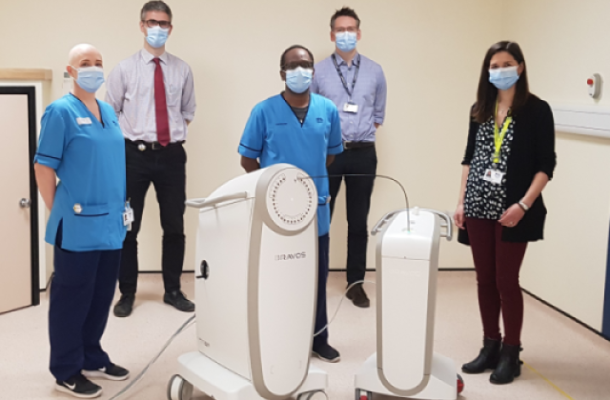
Image Credit: © NHS Tayside Communications
|
||
|
||
|
The Tayside Cancer Centre in Ninewells Hospital will deliver faster, targeted treatment to NHS Tayside patients with cervical or uterine cancers, as they announce the opening of a “state-of-the-art” cancer treatment unit.
Head of Radiotherapy Physics at NHS Tayside, Sankar Pillai, says this new unit will advance patient therapy in the Tayside Cancer Centre, which treats patients from across Tayside and North Fife.
By providing brachytherapy – an internal radiation treatment using capsules, seeds or ribbons placed in or near a tumour, which contain a source of radiation – the unit is equipped to provide shorter treatment times than more traditional methods.
Not only will this prevent patients being isolated for long periods of time, but it will enable Ninewells Hospital to admit more patients to their cancer centre, which sees over 2400 new patients a year currently, says Mr Pillai:
“This new high dose rate brachytherapy equipment will mean patients can have their treatment delivered over 30 minutes as opposed to 17 hours, which is how long it currently takes.
“This is a massive improvement for patients as it means less time isolated in a brachytherapy suite. Having this new treatment unit and a shorter treatment time will also allow us to see more patients and gives us the opportunity to expand the service in the future and develop new treatments for other types of cancer.”
Cancer diagnoses via emergency care made-up more than a third of all cancer diagnoses in Scotland in 2012-2017, recently published research showed. Clinicians voiced concerns that rates will be even higher post-pandemic.
Professor Ghulam Nabi, NHS Research Scotland Clinical Lead in Cancer for the East of Scotland, told healthandcare.scot that evidence from the frontline suggests these delayed presentations means there has been more cases of complications, where cancer has spread or advanced.
Andy Glyde, CRUK’s senior external affairs manager in Scotland, said the report’s findings were“truly worrying”.
He added: “It confirms that too many people in Scotland are only being diagnosed with cancer once their health has deteriorated to a point when they might need to be rushed into hospital.
“We know one reason so many people end up in A&E is because we don’t have enough staff and kit to test and diagnose cancer through usual routes.”
With more patients diagnosed and requiring treatment in the advanced stages of cancer, including a reported 70% increase in Stage III cervical cancer from 2019 to 2020, expanding treatment facilities will help clinicians better support patients.
While brachytherapy is central to the treatment of cervical and uterine cancer, the centre also provides chemotherapy, immunotherapy and other forms of targeted therapies. Staff of the new unit, Mr Pillai says, are proud of the service they will now be able to provide:
“Commissioning this new technology has been a multi-disciplinary team effort involving radiotherapy physicists, radiographers, nurses and oncologists. The team at Tayside Cancer Centre are proud to be able to offer this new service to our patients.”
Public Health Scotland have reported “a disruption of cervical cancer screening” during the pandemic may explain reduced diagnoses of early-stage cervical cancer. Innovative treatment services like this across Scotland could help morepatients at this stage.
The Scottish government launched a consultation, seeking views on its ten-year priorities in a new cancer strategy, which is due to close on the 7th June. The NHS recovery plan committed £130m to the Detect Cancer Early Programme.
Read more: Pandemic impact on cancer incidence in Scotland;Radiography service halted after cancer row;NHS Lanarkshire out of code black
Sign up to our bulletin for key health & social care updates straight to your inbox. |
