|
UK policies "killing people", says Health Secretary |
Related newsNew directions to NHS on staffing and deficits Scotland at the table with UN healthy air commission Pharmacy’s road to stigma-free drug dependency care ‘Whole-system shift’ needed on ADHD and autism support “Mayday”: voices from NHS emergency departments Doctors: ‘Shocking’ A&E figures require action Why you can’t miss the UK Stroke Forum 2025 NHS board savings push could see AI replace staff Aberdeen A&E first to offer routine HIV tests Aberdeen honours UK’s first occupational therapist 20 years of stroke research and recovery at UKSF 2025 Last chance for UK Stroke Forum early bird rate 
|
|
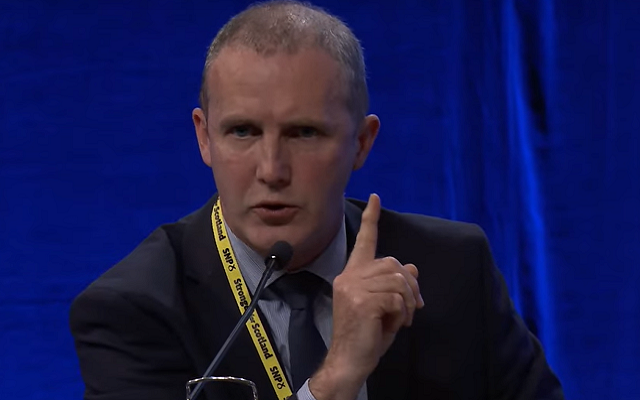
Cabinet Secretary for Health Michael Matheson MSP
|
||
|
||
|
Scotland’s Health Secretary has today told SNP supporters that growing privatisation of England’s health service will “starve” Scotland’s NHS.
Michael Mathson MSP this morning told the SNP conference in Aberdeen that the UK government’s austerity policies are “literally killing people” and Scottish independence will be the only way to protect the NHS and fight inequality.
Raising these concerns at a panel session on the party’s priorities, Mr Matheson said that the SNP government has chosen to ensure healthcare remains in the public sector:
“What’s happening with increasing privatisation of the health service in England, instead of making investment from the treasury into the service, they are actually getting private companies to provide that investment. These companies provide the equipment, they provide the building, and they provide the staff – the NHS just pays them a fee for provision of that service.
“As they ramp up privatisation, the amount of money Scotland will be allocated through the block grant will continue to decline.
“We can’t afford to continue to be in a union that is going to privatise a key part of its public sector as it starves our NHS in Scotland. That’s the consequence of our union in the UK.”
Mr Matheson argued that rising health inequalities and mortality rates over the last decade highlight the need for Scotland to be given more powers to tackle the lingering effects of austerity.
He told attendees: “The economic and fiscal policy that has been taken forward at a UK level, it is not only damaging people’s health, it’s quite literally killing people.”
Free prescriptions
Free prescription charges were raised by the Cabinet Secretary as a priority of the Scottish government that ensures everyone in the country can access the care and treatment they need.
A poll of 1,056 Scots, conducted by Our Scottish Future – an organisation set up by Gordon Brown – found that 54% support scrapping free prescriptions for middle and high earners.
Mr Matheson told conference attendees that, with patients now paying around £9.65 for each item prescribed by their doctor, a failure of Westminster to abolish charges tells a “tale of two governments” diametrically opposed:
“Let’s keep in mind why we abolished prescription charges here in Scotland and why we prioritise that as a government: there was evidence that demonstrated that many people were finding the cost of prescriptions too high and could no longer afford to take the medication that was prescribed by their clinicians.
“If we continued to have prescription charges here in Scotland, probably broadly in line with where they are in England, you can imagine the many households, particularly during the cost-of-living crisis, who would be quite literally turning their backs on the treatment their doctors are prescribing for them.”
Industrial action
Scotland is the only UK nation this year to have avoided industrial action by any group of healthcare professionals.
Recent pay negotiations have seen most NHS staff receive an average of a 6.5% pay rise, plus a one-off payment and a commitment to modernise the ‘outdated’ pay model.
Mr Matheson told the conference that England’s “plague” of industrial action has cost the UK more than £1bn, left more than 7.5 million people on waiting lists and led to more than one million cancelled appointments:
“We’ve made the choice to work with our trade union colleagues and staff-side representatives, in order to try and avoid industrial action.
“It’s important to recognise that the NHS is not the big fancy buildings, or the high-tech equipment – it’s the people who work in the service.
“When we make an investment in our staff, we make an investment into the system and into the quality of healthcare provision that patients will receive.”
Read more: Junior doctor strikes on pause; Auditor General: Difficult choices for Scotland's NHS; RCN: Staff need to see light at the end of the tunnel; Emails show haste to publish recovery plan; Inquiry launched for rural healthcare
Sign up to our bulletin for key health & social care updates straight to your inbox and you can follow healthandcare.scot on Google News. |
