|
MS rehab levels up with virtual reality games |
Related newsPartnership seeks early Alzheimer’s blood test Music’s potential to help with dementia International recognition for Dundee trials team Dementia home care tech collab invites partners Harnessing a parasite to take drugs into the brain Scotland to host Alzheimer’s research competition Medical trainee abuse reports ‘shut down and silenced’ Politicians must take ‘bold’ action on child poverty Glasgow district nurses ready to strike NHS and Glasgow rethink routes into healthcare ‘Major’ update to One Health AMR register Glasgow LEZ success sparks call for expansion 
|
|
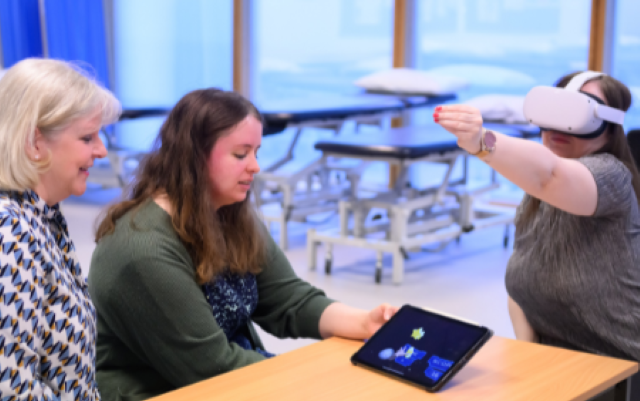
Image Credit: © Glasgow Caledonian University.
|
||
|
||
|
Glasgow researchers have developed virtual reality games to support the rehabilitation and improve the lives of people living with multiple sclerosis (MS).
Researchers from Glasgow Caledonian University’s School of Health and Life Sciences and Glasgow School of Art are now working with NHS Lanarkshire to test the games and get feedback from people living with the neurological condition.
As MS can cause vision, mobility and balance problems as well as fatigue, the project sought to find an enjoyable way to engage in movement and rehabilitation for people living with MS.
People taking part use headsets to enter a virtual reality, where scenes and objects appear to be real, with scenarios including making it look and feel like you’re floating in space.
Designed to bring together fun and mobility, the games developed for the study include whack-a-mole and catch-a-falling star, as well as the opportunity to play a virtual piano.
People with MS who have tried them so far have reported benefits to their mobility and ability to exercise.
Lauren Forrester, 39, from Lanarkshire described the project as a “game-changer”.
She said the VR games have been really helping her to improve her upper limb movement in a way that makes rehab feel less like work:
“Rehabilitation has been so important to me, but there is no avoiding the fact that it gets tedious. The work that Amy [lead researcher] has put into her games is a game-changer in this respect.
“I can't overstate how valuable I found it, being able to disconnect from the idea of rehab and just enjoy something light-hearted instead! The games are excellent for this!
“The focus becomes having fun, and who doesn't love the challenge of trying to beat a high score? Meanwhile, there's the added bonus of physical benefits that are useful every day.”
Lead researcher Dr Amy Webster, whose work has been funded by the MS Society, developed the games with direct input from people living with MS and hopes, by engaging in a fun activity, they will help users with motivation to keep up with rehab:
“We’ve had really good results and feedback so far, such as seeing the advantages compared to traditional physiotherapy and enjoying the distraction virtual reality can provide.
“People with MS have also reported that they found some benefits from taking part in terms of their mobility and increasing exercise, which is really encouraging! Working with Lauren and other people living with MS was so rewarding and insightful.”
With Scotland home to some of the highest rates of MS in the world, Glasgow Caledonian University researchers have been working on understanding and treating the disease for years.
Professor Lorna Paul, who leads the Doctoral Training Centre and supported Dr Webster, said:
“Amy’s research is being taken forward by one of the eight PhD students in our MS Doctoral Training Centre for symptom management where we are investigating exercise for people moderately affected by MS and in particular novel ways to encourage people to exercise, like VR.
“We are so grateful for Lauren and all the people affected by MS who support and take part in our studies – they are an amazing, inspirational group of people!”
Read more: Music’s potential to help with dementia; Tailored support needed for stroke survivors; Genome research sees £46.3m boost; Edinburgh team seek new insights into MS progression; Action needed on women’s brain health; Aberdeen team find genetic anxiety ‘switch’
Sign up to receive our bulletin for key health & social care updates straight to your inbox. |